

The Tenor
The Teacher
The Philantropist
The voice that moved the world: a journey through talent, dedication, charisma, and humanity
A long artistic journey led Luciano Pavarotti onto the stages of the most prestigious theaters in Italy and around the world. An unbroken career and total dedication to his work transformed the tenor from Modena into an ambassador of Bel Canto and Italian culture worldwide.
Music was Maestro Pavarotti’s passion and gentle obsession for over forty years, and he changed the face of opera forever.
“People think that I am disciplined. It’s not discipline, it is devotion. There is a big difference.“
Luciano Pavarotti

History
The long artistic journey

Luciano as a child
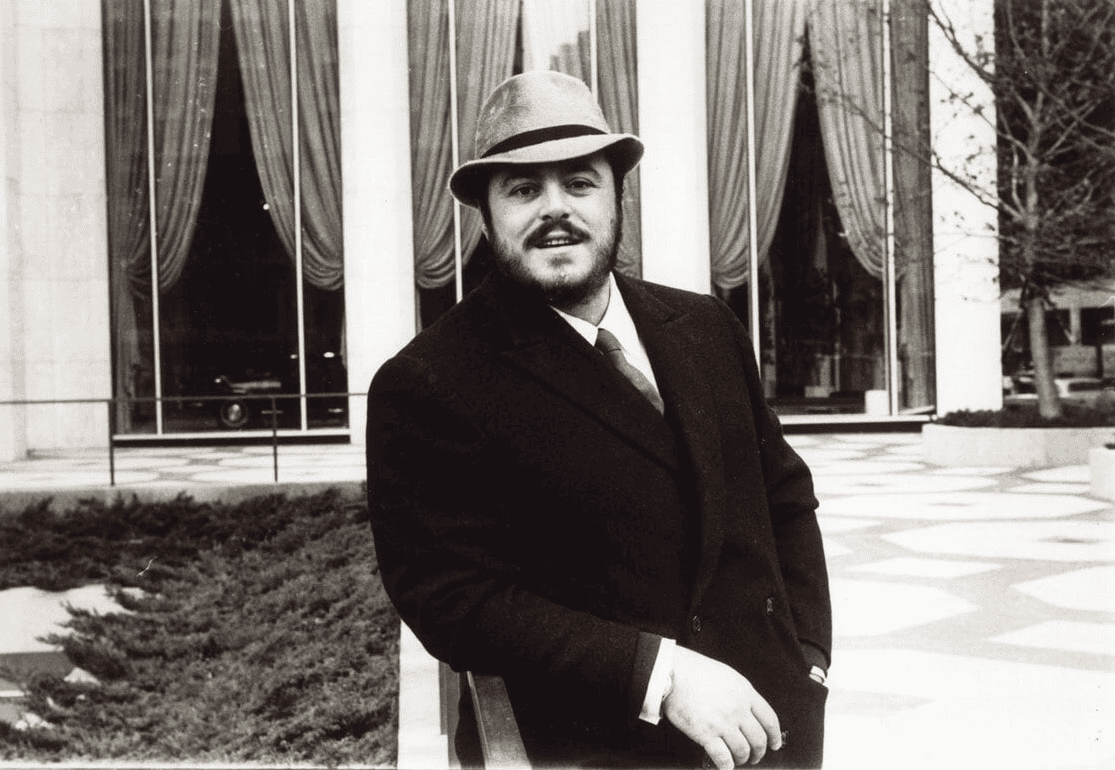
Luciano Pavarotti was born in a large public housing block on the outskirts of Modena on October 12, 1935, the son of Fernando Pavarotti, a baker and amateur tenor, and Adele Venturi, a worker at the tobacco factory.
World War II forced the Pavarotti family to leave the city in 1943 and relocate to the nearby countryside, where young Luciano developed a lasting affection for the rural environment and the Modenese landscape.
Pavarotti’s earliest musical influences and his passion for Italian bel canto came from his father’s record collection, which included many recordings by the famous tenors of the time: Beniamino Gigli, Giovanni Martinelli, Tito Schipa, and Enrico Caruso. However, young Luciano’s favorite tenor was Giuseppe Di Stefano; he was also deeply influenced by Mario Lanza, of whom he was a fervent admirer.

Luciano the student
At around nine years of age, young Luciano had his first musical experiences in his city’s choir, the Corale Gioachino Rossini, together with his father. After a normal and carefree childhood filled with a typical interest in sports (especially soccer), Pavarotti earned his teaching diploma from the Scuola Magistrale and became an elementary school teacher, then faced the dilemma of which path to take. » Read more

The debut
When Maestro Pola moved to Japan, Pavarotti became a student of Ettore Campogalliani in Mantua, who at that time was also teaching Pavarotti’s childhood friend, Mirella Freni. Like Pavarotti, Freni was destined for a great operatic career: they shared the stage many times and recorded memorable albums. During his music studies, Pavarotti took part-time jobs to support himself: first as an elementary school teacher, then as an insurance agent. After several smaller recitals, Pavarotti won the prestigious Achille Peri International Competition, which secured his debut on April 29, 1961, as Rodolfo in Puccini’s La Bohème at the Teatro Municipale Valli in Reggio Emilia, conducted by Francesco Molinari Pradelli and staged by Mafalda Favero.

International breakthrough
The great public and critical success of that first performance opened the world’s doors to the young tenor. Conductor Tullio Serafin invited him to sing the Duke of Mantua in Rigoletto in Palermo. Pavarotti’s future career was taking shape.
A long series of engagements, including international ones, followed that first year of activity. In 1963 Pavarotti made his debut at the Vienna State Opera; a few months later came his debut at the Royal Opera House in London, where he stood in for an unwell Giuseppe Di Stefano as Rodolfo. Pavarotti often recalled this fortunate circumstance as his true baptism on the international opera stage, which brought him fame and recognition from audiences and critics.

King of the High C
From that same period came his recording debut with Decca, and his meeting with conductor Richard Bonynge and his wife, soprano Joan Sutherland. Joan Sutherland was looking for a young tenor to take on tour in Australia, and Pavarotti seemed ideal. The two gave around forty performances over two months, and Pavarotti later acknowledged his debt to Sutherland for the breathing and diaphragm technique he learned from her, which sustained him throughout his career. Together with the Sutherland–Bonynge duo, Pavarotti made his United States debut in 1965, singing Edgardo in Donizetti’s Lucia di Lammermoor at the Miami Opera; other memorable performances with Sutherland included Bellini’s La sonnambula, Verdi’s La traviata and, in 1966, La fille du régiment by Donizetti at the Royal Opera House. In this performance, Pavarotti confidently delivered (the first tenor ever to do so) the legendary series of nine natural high Cs in the aria Ah! mes amis, which sent the audience into raptures and etched the Modenese singer’s name into opera history as the “King of the High C.”

Gems of Bel Canto
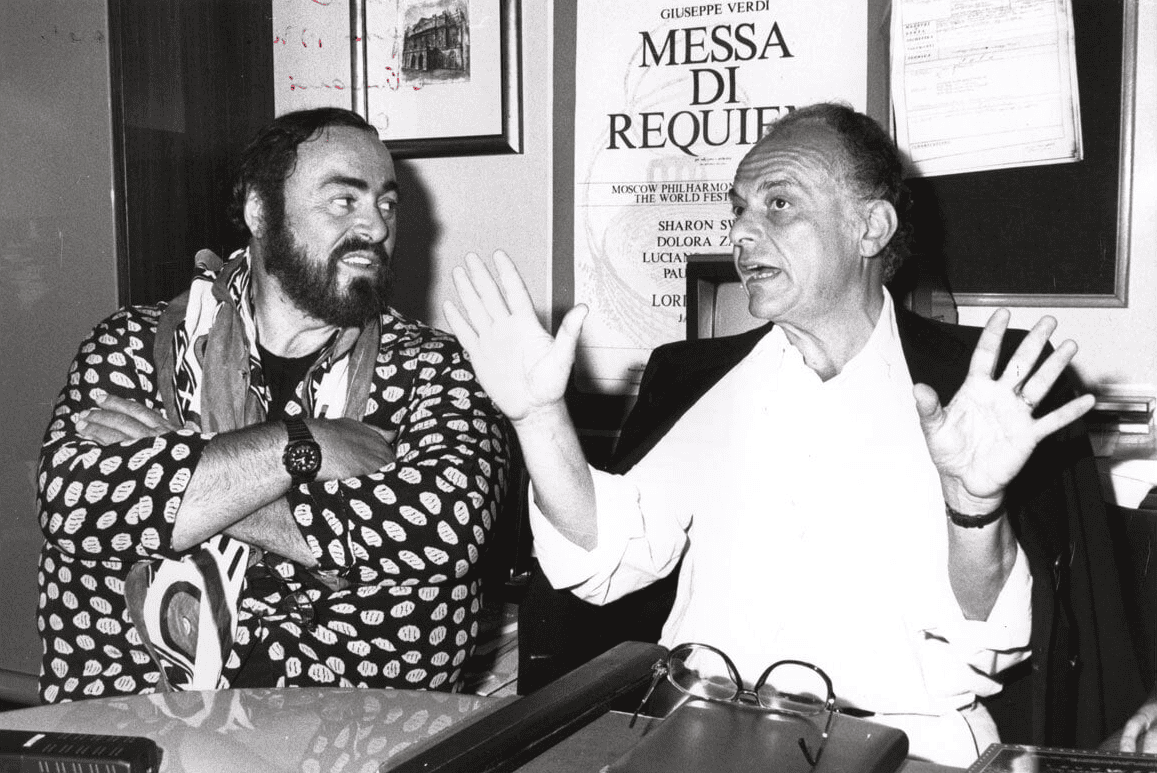
1965 marked his debut, on April 28, at La Scala in a Bohème conducted by Herbert von Karajan with staging by Franco Zeffirelli; the following year, Pavarotti had the great honor—as he liked to say—of being invited by Karajan for Verdi’s Requiem Mass in memory of Arturo Toscanini. Those years were rich in successes for Pavarotti. Claudio Abbado conducted him in a historic production of Bellini’s I Capuleti e i Montecchi at La Scala, and Gianandrea Gavazzeni in Verdi’s Rigoletto. His debut at the Metropolitan Opera in New York took place in 1968 with Bohème, and in February 1972 another performance of La fille du régiment earned him a record 17 curtain calls. The world acclaimed him as the perfect interpreter of Italian bel canto, in Verdi roles and in warhorses such as Bohème, Tosca, and Madama Butterfly. Pavarotti scored another major success in Rome, on November 20, 1969, singing I Lombardi with Renata Scotto. The Modenese tenor debuted as a soloist in a recital at William Jewell College in Liberty, Missouri, on February 1, 1973, as part of the College’s Fine Arts Program.

Ever larger audiences
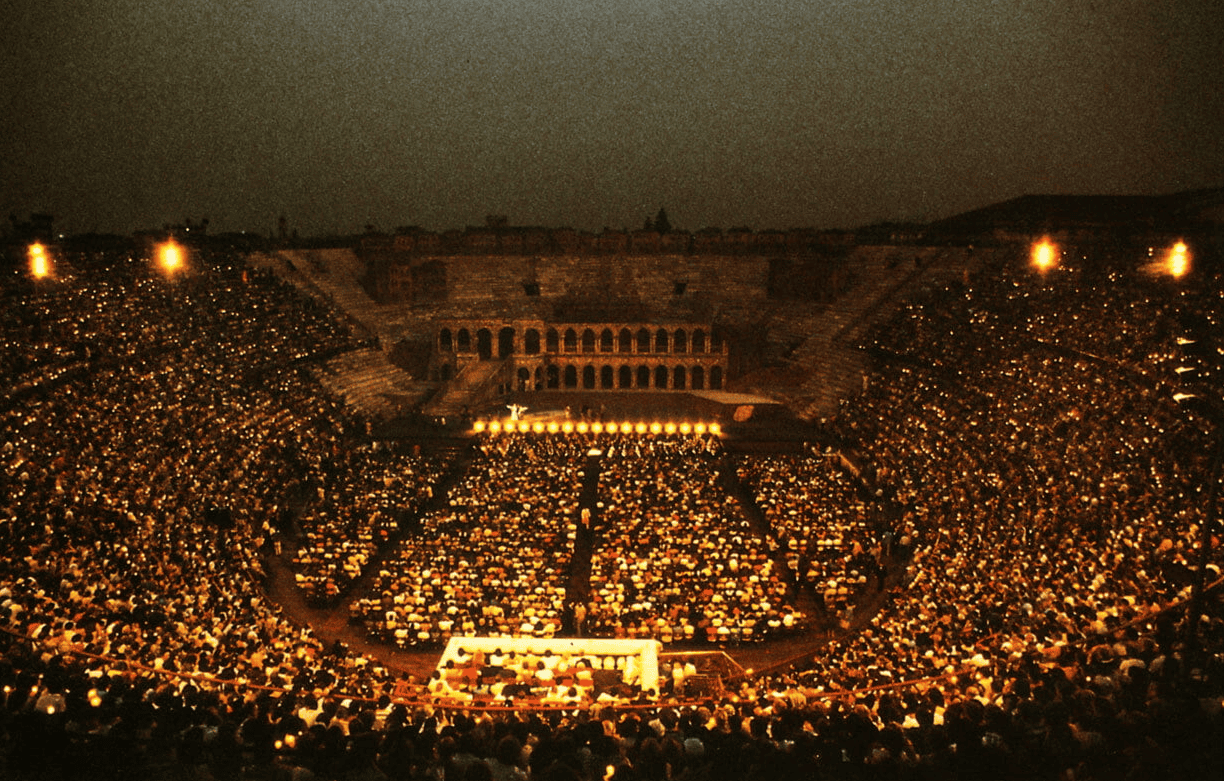
His recordings from those years—over one hundred across his career—received numerous gold and platinum records and Grammy Awards (in 1978, 1979, and 1981), while the broader public came to appreciate him thanks to his increasingly frequent television appearances: in 1977, his Bohème conducted by James Levine, the first telecast from the Metropolitan Opera in New York, set a TV audience record. Among the most notable recordings of that period are La favorita with Fiorenza Cossotto and I puritani with Sutherland. 1976 marked his debut at the Salzburg Festival in a solo recital, followed two years later by appearances in Richard Strauss’s Der Rosenkavalier and, in 1983, Mozart’s Idomeneo; in 1977 he returned to the Vienna State Opera with Karajan in Il trovatore, and in 1978 he achieved extraordinary success in a recital at New York’s Lincoln Center. In 1980, his concert version of Rigoletto at Central Park in New York drew over 200,000 spectators.

“Celeste Luciano”
In the early 1980s, his successes multiplied: Pavarotti was acclaimed in Vienna in a Bohème conducted by Carlos Kleiber (January 1985) alongside Mirella Freni as Mimì; in an Aida conducted by Lorin Maazel (April–June 1984) where he sang Radamès; he was an extraordinary Gustavo in Un ballo in maschera conducted by Claudio Abbado (October 1986); and at La Scala in 1985 an unforgettable Aida conducted by Maazel and staged by Luca Ronconi, unsurpassed in significance. The aria “Celeste Aida” received a standing ovation lasting many minutes, and the next day newspapers headlined “Celeste Luciano.”
The album Essential Pavarotti, released in 1982, was the first classical album to reach the top of the UK pop charts, remaining there for five weeks.

Maestro and young singers
Luciano Pavarotti never forgot the generosity of his first teacher and, once a professional tenor, began to teach young people (he did so throughout his life), always for free. He wanted to give back what he had received.
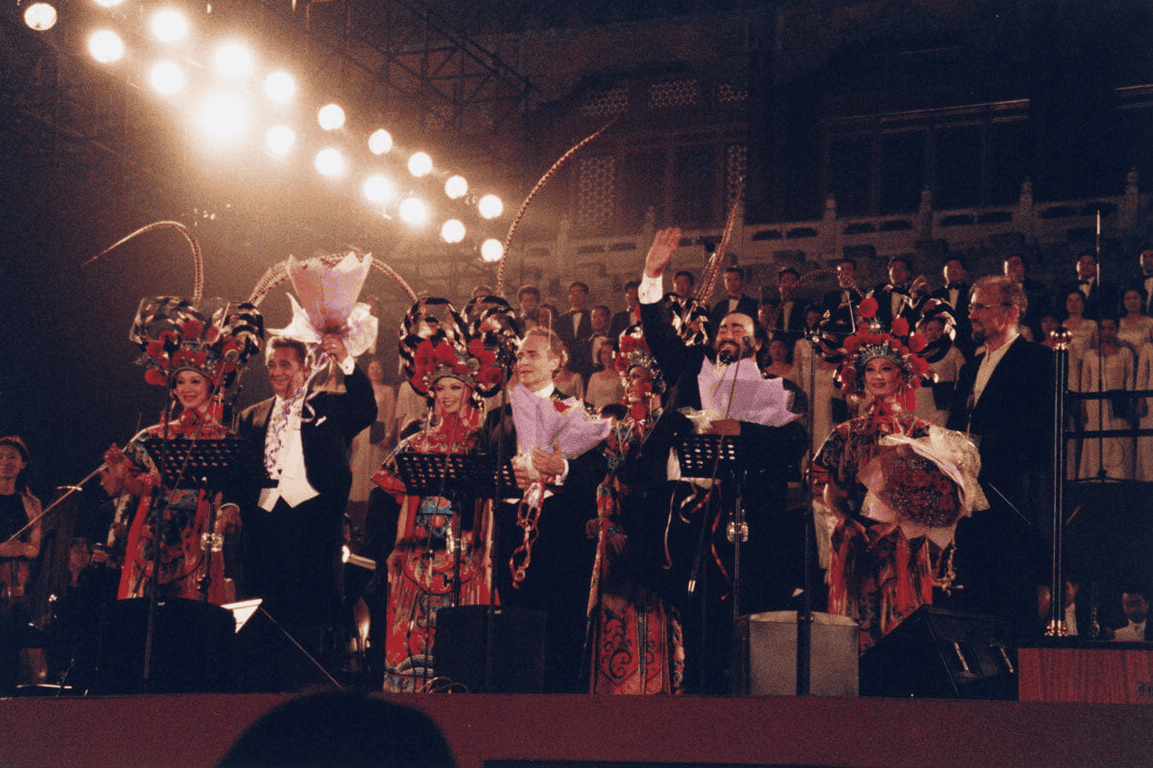
In the early 1980s, his commitment to promoting young opera talents culminated in the Pavarotti International Voice Competition in Philadelphia. The prize was the chance to perform an entire opera alongside the great tenor: there were many performances with newcomers, such as a remarkable production of La Bohème in Beijing in 1986. That trip to the East had unique features: among other things, the theatre company and Pavarotti flew on the first Italian commercial flight to land on Chinese soil. At the conclusion of that extraordinary visit, during which the tenor was greeted everywhere by throngs of admirers, Pavarotti performed the first concert ever held at the Great Hall of the People (previously considered off-limits for performances) before 10,000 people.

Nessun Dorma
Pavarotti reunited with Mirella Freni as his partner in San Francisco Opera’s production of La Bohème in 1988. In 1992, La Scala featured Pavarotti in a new, and controversial, production of Don Carlo by Zeffirelli, conducted by Maestro Riccardo Muti.
Pavarotti’s fame grew even further worldwide in 1990, when he performed in The Three Tenors concert—together with Plácido Domingo and José Carreras—on the eve of the World Cup Final at the Baths of Caracalla in Rome. His rendition of the aria “Nessun Dorma” from Puccini’s Turandot became the BBC’s soundtrack for the FIFA tournament, and the recording turned into the best-selling classical album of all time. Building on the success of the original 1990 concert, the Three Tenors gave additional concerts during subsequent World Cups: in Los Angeles in 1994, Paris in 1998, and Yokohama in 2002.

Bringing opera to the masses
For over a decade, Pavarotti’s name had become synonymous with opera. Thanks to his unique and unparalleled voice and his gifts as an empathetic, outgoing, and charismatic communicator, the Modenese tenor continued to broaden the audience for this art form, also by throwing open the theater doors and meeting people in parks, stadiums, and arenas. Bringing opera to the people, making it as popular as possible, suited his generous and open artistic personality and his unconventional musical outlook. » Read more

Music without borders
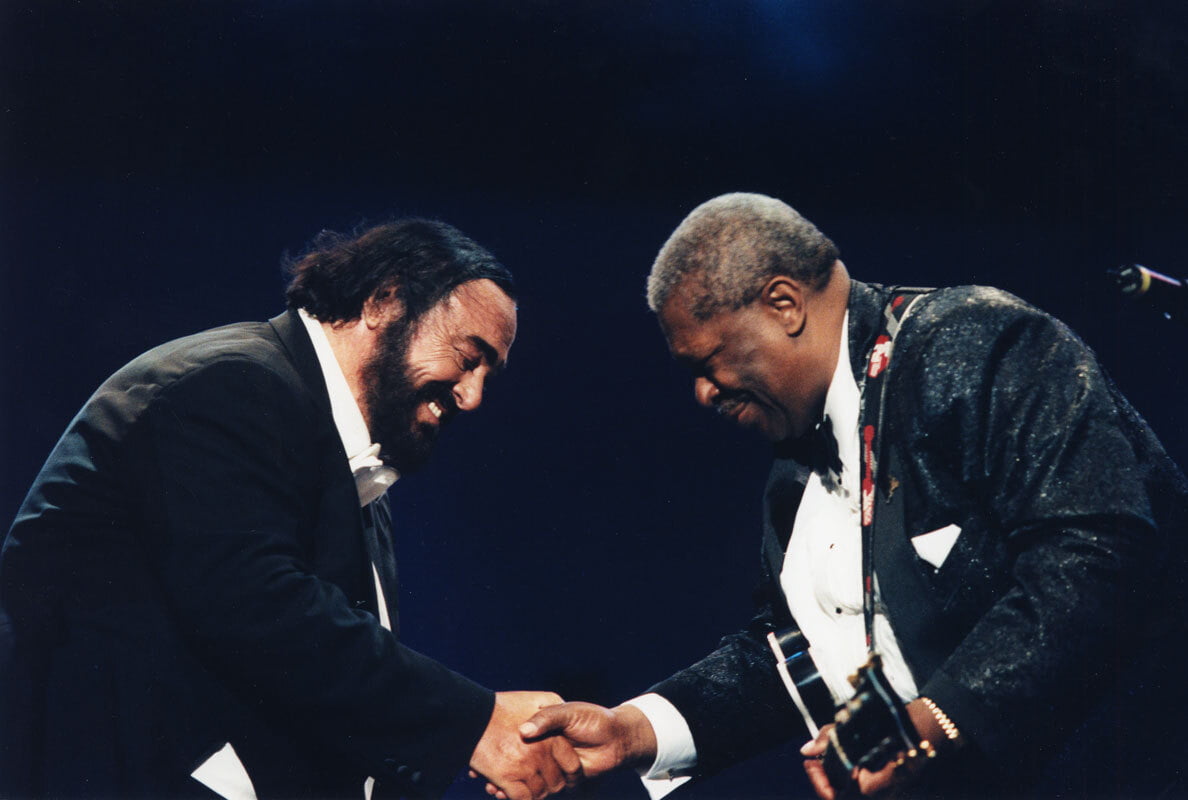
In 1992, combining his longstanding passion for horses with his inexhaustible curiosity and desire to take on new experiences, Pavarotti launched the annual equestrian event Pavarotti International; alongside it, he created the concert Pavarotti & Friends, a reunion of major artists from different genres—from opera to pop and rock—who performed duets with the tenor in support of charitable causes, primarily benefiting children. These events raised millions of dollars to provide medical aid and fund social-educational projects in Bosnia, Cambodia, Kosovo, Guatemala, Liberia, and Tibet, as well as for Afghan, Angolan, and Iraqi refugees.
In 1996, at the age of 61, Pavarotti made his final operatic debut in Umberto Giordano’s Andrea Chénier before the audience of the Metropolitan Opera in New York.

Awards
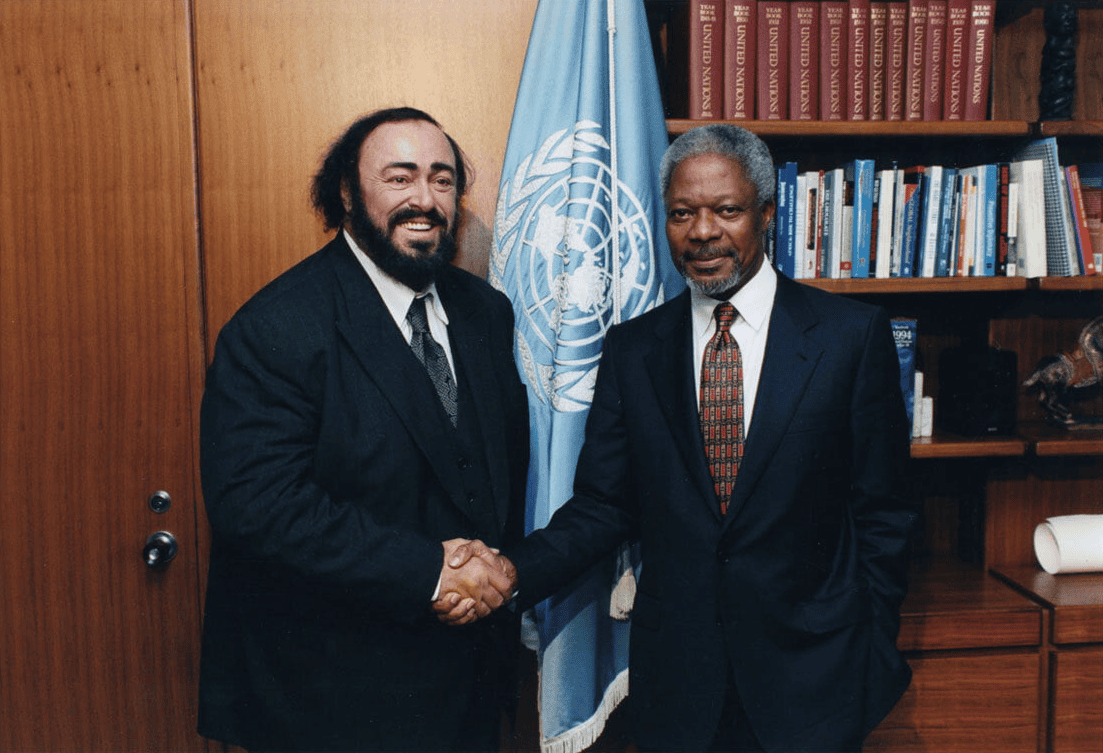
Luciano Pavarotti was the recipient of an extraordinary number of international honors and received an equally remarkable array of awards (over 500), including, to name only a few: Knight Grand Cross of the Order of Merit of the Italian Republic; 2 Emmys, numerous Gramophones, and 6 Grammy Awards (including the Grammy Legend Award in 1998); he was named an Officer of the Légion d’Honneur and MusiCares Person of the Year; he received 6 honorary degrees. In 1998, Pavarotti was appointed a United Nations Messenger of Peace by Secretary-General Kofi Annan, while in 2001 the United Nations High Commissioner for Refugees (UNHCR) honored the tenor with the Nansen Award, recognizing him as having helped raise more funds for refugees than any other private individual. » Read more

The man who moved the world
Pavarotti gave his last performance in an opera, Tosca, on the stage of the Metropolitan Opera in New York on March 13, 2004. At the end of the performance, the moved audience seemed unwilling to let him go, recalling him to the stage 11 times.
On February 10, 2006, the tenor sang "Nessun Dorma" at the Opening Ceremony of the 2006 Winter Olympics in Turin, Italy: it was his final performance, followed by the longest and loudest ovation of the evening from the international audience.
Luciano Pavarotti passed away at his home in Modena on September 6, 2007, surrounded by his family’s love.